
This is a new project for AI realisation, that means new type of artificial intelligence assistant in real life. Drone above the head with cameras, GPS, Wi-Fi, CPU and application with self training AI.
See more information later.
This is a new project for AI realisation, that means new type of artificial intelligence assistant in real life. Drone above the head with cameras, GPS, Wi-Fi, CPU and application with self training AI.
See more information later.
Artificial Intelligence (AI) is the study of computer science focusing on developing software or machines that exhibit human intelligence.
A lot of people think that AI is just a sci-fi concept that’s being used in movies like Star Wars, Terminator or Lucy, but there is a lot more to it. AI is a very broad topic ranging from a simple calculator to self-drive technology to something that might change the future.

Nvidia CEO Jen-Hsun Huang apparently hand-delivered a DGX-1 to OpenAI researchers last week in San Francisco, Calif. Dubbed an “AI supercomputer-in-a-box”, the DGX-1 will be used by the non-profit research team to explore the challenges surrounding artificial intelligence.
Continue reading Nvidia offers up AI supercomputer for non-profit research
The development of AI in financial investments now is experiencing exponential growth and is rapidly bringing us closer to the singularity. This shows the great interest in the areas of research that will lead to the rapid development of the industry in the near future. 2015 was the best year in Artificial Intelligence funding with almost $1.2B raised, according to VentureScanner with data of investing in startups in the world and in Q1 2016 trend is still positive. The subdivision of CBInsight VentureScanner in the first quarter of 2016 was tracking 957 AI companies with a combined funding amount of $4.8 Billion. The main amount of companies concentrated in the US – 499, with the United Kingdom at a distant second with 60.

Artificial Intelligence startups total funding by year (by VentureScanner)
Continue reading AI Startups statistics in Q1 2016 by Venture Scanner

New lip-reading technology developed at the University of East Anglia (UEA) could help in solving crimes and provide communication assistance for people with hearing and speech impairments.
The visual speech recognition technology, created by Dr Helen L. Bear and Prof Richard Harvey of UEA’s School of Computing Sciences, can be applied “any place where the audio isn’t good enough to determine what people are saying,” Dr Bear said.
Continue reading Read my lips: New technology spells out what’s said when audio fails

The IBM Watson AI XPRIZE, a Cognitive Computing Competition, was announced on the TED Stage on Feb 17, 2016. It is a $5 million competition challenging teams from around the world to develop and demonstrate how humans can collaborate with powerful cognitive technologies to tackle some of the world’s grand challenges.
Every year leading up to TED2020, teams will go head-to-head at World of Watson, IBM’s annual conference, competing for interim prizes and the opportunity to advance to the next year’s competition.

The company has open sourced the artificial intelligence framework it uses to power speech recognition in its Cortana digital assistant and Skype Translate applications. This means that anyone in the world is now free to view, modify, and use Microsoft’s code in their own software.
The framework, called, CNTK, is based on a branch of artificial intelligence called deep learning, which seeks to help machines do things like recognize photos and videos or understanding human speech by mimicking the structure and functions of the human brain. Tech giants like Microsoft, Google and Facebook have invested heavily in deep learning research for years, going so far as to hire many of academics who pioneered the field. Now, just as academics publish their research so that it can be critiqued and advanced by other researchers, these companies are releasing their deep learning software in much the same way.
Continue reading Microsoft Open Sources Its Artificial Brain to One-Up Google
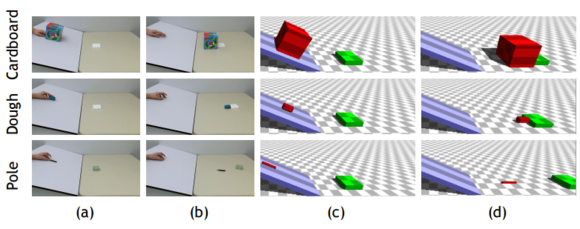
That’s where Galileo comes in. Developed by MIT’s Computer Science and Artificial Intelligence Lab (CSAIL), the new computational model has proven to be just as accurate as humans are at predicting how real-world objects move and interact.
Continue reading Galileo – a new AI system from MIT that could help robots help us during disasters
Artificial Intelligence is constantly pushing the boundaries of what machines are capable of. But could machines ever become better than us? The answer is of course ‘yes’, at least in many things where our intellect used to be the unchallenged champion of creativity and intelligence. Here are 5 tough intellectual areas where AI is already performing better than humans.
Artificial intelligence is one of the most exciting and transformative opportunities of our time. From my vantage point as a venture investor atPlayfair Capital, where I focus on investing and building community around AI, I see this as a great time for investors to help build companies in this space. There are three key reasons.
First, with 40 percent of the world’s population now online, and more than 2 billion smartphones being used with increasing addiction every day (KPCB), we’re creating data assets, the raw material for AI, that describe our behaviors, interests, knowledge, connections and activities at a level of granularity that has never existed.